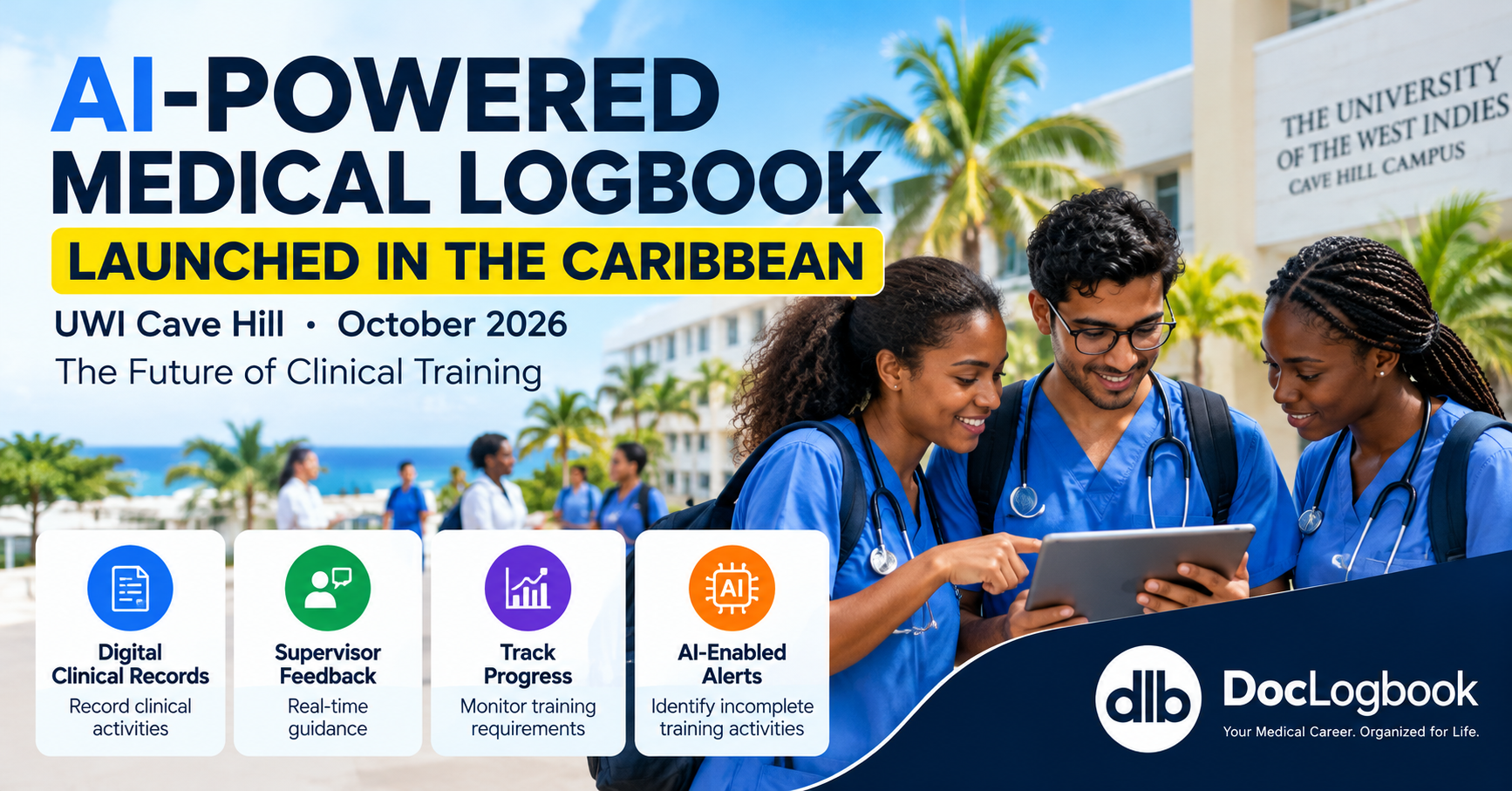
AI-Powered Medical Logbook Launched in the Caribbean: UWI Moves Beyond Paper-Based Clinical Training
A new AI-enabled eLogbook at the University of the West Indies signals an important shift toward digital medical education, competency tracking, and clinical documentation.
Medical education is undergoing a digital transformation, and a new development in the Caribbean highlights how universities are rethinking the way future doctors record their clinical experience.
On October 12, 2026, the University of the West Indies (UWI), Cave Hill Campus, Barbados, implemented an AI-enabled electronic Clinical Training Logbook (eLogbook) for its medical students.
The initiative replaces traditional paper-based clinical logbooks with a digital system designed to record clinical activities, monitor student progress, and facilitate real-time feedback from supervisors.
Announced officially on October 13, 2026, the project represents an important development in technology-supported medical training in the Caribbean.
It also highlights a broader trend: medical institutions are increasingly exploring digital tools to make clinical education more measurable, organized, and responsive.
For medical students, residents, surgeons, and training institutions worldwide, the announcement raises an important question:
Is the future of medical training moving from paper logbooks to intelligent digital clinical portfolios?
1. What Did the University of the West Indies Announce?
The University of the West Indies, Cave Hill Campus, introduced its AI-enabled electronic Clinical Training Logbook during the Faculty of Medical Sciences' Clinical (Junior) Orientation Day.
The system was implemented for medical students in the Class of 2029.
According to the university's official announcement, the platform is intended to help students and clinical supervisors document practical training and monitor progress throughout clinical education.
The system introduces several capabilities:
- Electronic recording of clinical training activities
- Monitoring of student progress
- Real-time supervisor feedback
- Identification of incomplete clinical training activities
- Documentation of clinical experiences across healthcare settings
- Support for training assessment and accreditation documentation
Both students and supervisors are expected to receive training in using the new platform.
The university described the implementation as a move away from traditional paper-based recording toward technology-supported clinical education.
Official announcement: New Technology to Enhance Medical Training at UWI Cave Hill
2. How Does the AI-Enabled Medical eLogbook Work?
The new system is designed to support clinical education by combining digital documentation with progress monitoring and supervisor feedback.
Recording Clinical Experience
Medical students can document their practical activities during clinical placements.
At UWI, these experiences may take place in hospitals, polyclinics and community healthcare settings.
Instead of maintaining separate paper records, students can record their activities electronically.
Supervisor Review and Feedback
Clinical supervisors can review documented activities and provide feedback.
This helps students understand their progress and identify areas requiring further development.
It also allows faculty members to assess whether clinical training objectives are being achieved.
AI-Enabled Alerts
One of the most interesting features announced by the university is the ability to identify required clinical training activities that have not yet been completed.
The platform can alert students and supervisors when gaps are identified.
This approach could help medical educators intervene earlier when students need additional clinical exposure.
Longitudinal Clinical Training Records
The system is also intended to maintain electronic records of clinical training.
According to the university, these records may support accreditation processes and legal documentation.
This is important because clinical training records can serve purposes beyond an individual student's immediate assessment.
The university has not publicly detailed the underlying AI models, technical architecture or validation results. Therefore, its reported capabilities should not be interpreted as evidence of independently verified AI accuracy or improved educational outcomes.
3. An India–Caribbean Collaboration in Digital Medical Education
An especially interesting aspect of the announcement is the international collaboration behind the project.
According to UWI, the initiative emerged from a strategic partnership involving:
- The University of the West Indies, Cave Hill Campus, Barbados
- ERA University, Lucknow, India
- American University of Barbados, Barbados
Professor Alok Kumar Singh, Professor of Pediatrics and Deputy Dean for Research and Graduate Studies at UWI Cave Hill, described the initiative as an early outcome of the partnership.
The collaboration aims to advance medical education and healthcare through AI-enabled digital technologies, innovation and research.
The university also identified contributors from UWI and ERA University who worked on the eLogbook initiative.
Why Is This Partnership Significant?
Medical education challenges are not limited to a single country.
Students and residents across India, the Caribbean, Africa, Europe and other regions face similar problems:
- Maintaining accurate clinical training records
- Documenting experience across different hospitals
- Demonstrating competency development
- Obtaining meaningful supervisor feedback
- Preparing evidence for educational assessment
- Preserving professional records over time
Collaboration between institutions in different countries creates opportunities to develop digital solutions informed by varied medical education environments.
The UWI initiative is a useful example of how cross-border academic partnerships can support innovation in clinical training.
4. Why Are Medical Schools Moving Away From Paper Logbooks?
For decades, medical students and postgraduate trainees have used handwritten logbooks to record clinical cases, procedures, and educational activities.
Although paper logbooks remain useful in many settings, they have practical limitations.
Common Challenges With Paper-Based Medical Logbooks
1. Lost or damaged records
A physical logbook can be misplaced or damaged, potentially affecting access to years of recorded experience.
2. Delayed documentation
Students may record activities retrospectively, increasing the risk of omissions or inaccurate recollection.
3. Difficulty tracking training gaps
Reviewing hundreds of handwritten entries to identify missing clinical experiences can be time-consuming.
4. Limited feedback visibility
Written supervisor comments may be difficult to organize and revisit.
5. Challenges during multiple clinical rotations
Medical trainees often move between departments, hospitals, and healthcare facilities.
Maintaining continuity across these settings can be difficult with paper records alone.
6. Administrative workload
Faculty members may need to manually review individual logbooks to assess progress or prepare educational reports.
Digital logbooks can help address some of these challenges when they are well designed, consistently used, and supported by reliable supervision.
However, digitization alone does not guarantee accurate records, better feedback, or improved clinical competence.
5. From Case Counting to Competency-Based Medical Education
Traditionally, many clinical training systems have emphasized the number of cases or procedures completed.
For example, a trainee might record the number of:
- Patient examinations performed
- Surgical procedures assisted
- Procedures independently performed under appropriate supervision
- Emergency cases managed
- Clinical rotations completed
These records remain important.
However, the number of procedures performed does not necessarily establish clinical competence.
Competency-based medical education also considers the quality of performance, decision-making, supervision, feedback, and progression toward defined learning outcomes.
How Digital Logbooks Can Support Competency Tracking
A well-designed electronic logbook can potentially help educators:
- Compare documented experience with training objectives
- Identify gaps in clinical exposure
- Review performance across rotations
- Provide timely feedback
- Monitor progression over time
- Maintain more accessible assessment records
The UWI announcement is particularly relevant because its platform aims to connect clinical activity recording with supervisor feedback and identification of incomplete requirements.
This reflects an important direction for digital medical education: moving beyond recording what a trainee has done toward understanding what the trainee still needs to learn.
6. Could AI Change the Future of Medical and Surgical Logbooks?
Artificial intelligence is increasingly being explored in medical education, clinical documentation, and administrative workflows.
In the context of medical logbooks, AI could potentially support several functions.
Identifying Missing Training Requirements
An intelligent system may compare recorded activities against a defined curriculum and highlight areas with insufficient exposure.
Summarizing Clinical Experience
AI could potentially help summarize a trainee's recorded experience across departments and clinical rotations.
Supporting Personalized Feedback
Digital platforms may help supervisors identify recurring learning needs and provide more targeted feedback.
Reducing Administrative Work
Appropriately designed automation may reduce time spent organizing records and preparing reports.
Improving Training Oversight
Aggregated and appropriately governed data could help institutions understand whether students are receiving sufficient exposure to required clinical activities.
These are potential applications of AI in medical training—not claims that all these capabilities are available in the newly launched UWI system.
Any use of AI for clinical training assessment should also address accuracy, human oversight, data privacy, fairness, and transparency.
AI should support medical educators, not replace professional supervision or independent competency assessment.
7. What Does This Mean for Medical Students and Residents Worldwide?
The Caribbean announcement has relevance beyond Barbados.
Clinical documentation is a common requirement or expectation in many medical education systems, although the exact rules vary.
United States
ACGME-accredited residency programs in relevant specialties use official case-log systems and specialty-specific requirements to document clinical and procedural experience.
Digital records support training oversight, but the applicable ACGME requirements must be followed.
United Kingdom
Clinical experience and operative logbook evidence can form part of surgical training assessment and recruitment portfolios.
Applicants must follow the evidence formats and verification requirements specified by the relevant recruitment or training body.
India
Medical postgraduate training includes clinical and educational documentation under applicable institutional, university and regulatory requirements.
The precise logbook format and verification process depend on the programme and governing rules.
Africa
Regional surgical training organizations such as the College of Surgeons of East, Central and Southern Africa (COSECSA) have developed electronic logbook systems to support surgical training documentation.
Caribbean
The UWI Cave Hill initiative demonstrates how a Caribbean medical faculty is introducing electronic records and AI-supported progress monitoring into undergraduate clinical training.
These examples do not establish that every medical institution worldwide requires a digital logbook.
They do, however, illustrate the growing importance of structured clinical documentation in medical education.
8. Digital Medical Logbooks and Multi-Hospital Clinical Training
One challenge shared by medical trainees worldwide is the movement between different clinical settings.
A student or resident may receive training in:
- Teaching hospitals
- Community hospitals
- Specialty departments
- Outpatient clinics
- Emergency services
- Rural healthcare facilities
- Community health programmes
Each setting may provide different learning opportunities.
A structured longitudinal record can help trainees review how their experience develops across these rotations.
For institutions, properly governed records may also help identify whether particular training environments provide the expected clinical exposure.
The UWI platform's ability to document experiences across hospitals, polyclinics, and community activities makes this aspect particularly relevant.
9. How DocLogbook Supports the Broader Shift Toward Digital Clinical Records
The launch of UWI's AI-enabled eLogbook is another example of the growing interest in digital clinical training documentation.
It also reflects the broader problem that DocLogbook was created to address: helping doctors maintain organized records of their medical and surgical careers.
DocLogbook is an independent digital medical and surgical logbook designed for medical students, residents, surgeons, and practicing doctors.
Continuous Clinical Record-Keeping
Doctors can develop the habit of documenting their clinical and procedural experience regularly rather than attempting to reconstruct it later.
Multi-Hospital Experience Tracking
Medical careers frequently involve work across multiple hospitals.
DocLogbook's multi-hospital approach helps doctors organize their professional experience across different institutions.
A Career-Long Professional Record
A medical professional's clinical experience extends beyond a single examination, training programme, or hospital appointment.
DocLogbook is designed around the idea of maintaining an organized professional record throughout a doctor's career.
Clinical and Professional Organization
Structured documentation can help doctors review their past experience and prepare for professional discussions, interviews, and career transitions.
DocLogbook is available on Android, iPhone, and the web.
Explore the platform at:
DocLogbook — Your Medical Career. Organized for Life.
Important clarification: DocLogbook is not affiliated with the University of the West Indies, ERA University, or the American University of Barbados. It is not the platform launched at UWI Cave Hill and should not be treated as a replacement for university-prescribed logbooks, official assessment systems, or supervisor certification. Doctors must follow applicable institutional requirements and protect patient confidentiality when recording clinical information.
10. What Should Medical Institutions Consider Before Adopting an Electronic Logbook?
The UWI announcement may encourage other medical schools and training institutions to review their clinical documentation systems.
Before adopting a digital medical logbook, institutions should consider several questions.
Clinical relevance: Does the platform reflect the curriculum and required competencies?
Supervisor verification: Can authorized supervisors review and validate relevant activities?
Ease of use: Can students document activities efficiently during busy clinical rotations?
Data protection: Are patient identifiers minimized and access permissions appropriately controlled?
Training continuity: Can records be maintained across participating departments and hospitals?
Reporting: Can institutions assess training gaps and educational progress?
Reliability: Are records securely stored, backed up, and recoverable?
AI governance: If artificial intelligence is used, are its outputs explainable, validated, and subject to appropriate human review?
A successful digital transition requires more than purchasing software.
It also requires faculty engagement, clear documentation policies, training, reliable infrastructure, and appropriate governance.
Frequently Asked Questions
What is the new AI medical logbook launched in the Caribbean?
It is an AI-enabled electronic Clinical Training Logbook introduced by the University of the West Indies, Cave Hill Campus, to help medical students document clinical experience, receive supervisor feedback, and monitor training progress.
When was the UWI electronic logbook introduced?
The platform was implemented on October 12, 2026, and announced publicly on October 13, 2026.
Which medical students will use the new eLogbook?
The initial implementation was announced for UWI Cave Hill's medical Class of 2029 during its Clinical (Junior) Orientation Day.
Which institutions collaborated on the initiative?
The project emerged from a partnership involving UWI Cave Hill, ERA University in Lucknow, India, and the American University of Barbados.
What makes an AI-powered medical logbook different?
An AI-enabled logbook may provide additional functions such as identifying incomplete training requirements and supporting timely feedback. The exact capabilities depend on the platform.
Are digital medical logbooks mandatory worldwide?
No. Requirements differ by country, institution, training programme, and specialty.
Can electronic logbooks replace clinical supervisors?
No. Digital records and AI tools can support clinical education, but supervision and competency assessment remain professional responsibilities.
What is the difference between an institutional eLogbook and a personal digital medical logbook?
An institutional eLogbook is implemented within a specific educational programme and may support formal assessment and accreditation processes.
A personal digital medical logbook helps an individual doctor organize professional experience over time.
The two can serve complementary purposes, but an independent platform does not automatically satisfy an institution's official requirements.
Is DocLogbook the same platform used at UWI Cave Hill?
No. DocLogbook is a separate, independent digital medical and surgical logbook platform.
Conclusion: The Future of Medical Training Is Becoming More Digital
The University of the West Indies' October 2026 announcement marks an important step in the adoption of AI-enabled electronic clinical logbooks in Caribbean medical education.
By introducing digital documentation, supervisor feedback, and training-progress monitoring, UWI Cave Hill is exploring a more structured approach to clinical learning.
The collaboration with ERA University in India and the American University of Barbados also demonstrates how international academic partnerships can contribute to innovation in medical education.
The broader lesson is clear.
Clinical experience is valuable, but recording, reviewing, and learning from that experience is equally important.
As medical education evolves, digital logbooks may become increasingly useful tools for supporting clinical training, professional development and institutional oversight.
For doctors who want to maintain an organized record of their careers, platforms such as DocLogbook reflect this wider movement toward structured, lifelong clinical documentation.
References
1. University of the West Indies, Cave Hill Campus. New Technology to Enhance Medical Training at UWI Cave Hill. Published October 13, 2026.
2. The University of the West Indies. Official University Website.
3. ACGME. Case Log System.
https://www.acgme.org/data-systems-technical-support/case-log-system/
4. College of Surgeons of East, Central and Southern Africa. Training Platforms.
https://www.cosecsa.org/training-platforms/
Editorial disclaimer: This article reports a university announcement and discusses broader digital medical education trends. Published outcome studies have not yet independently established the educational benefits of the newly introduced platform. DocLogbook is not associated with the institutions involved in the announcement.