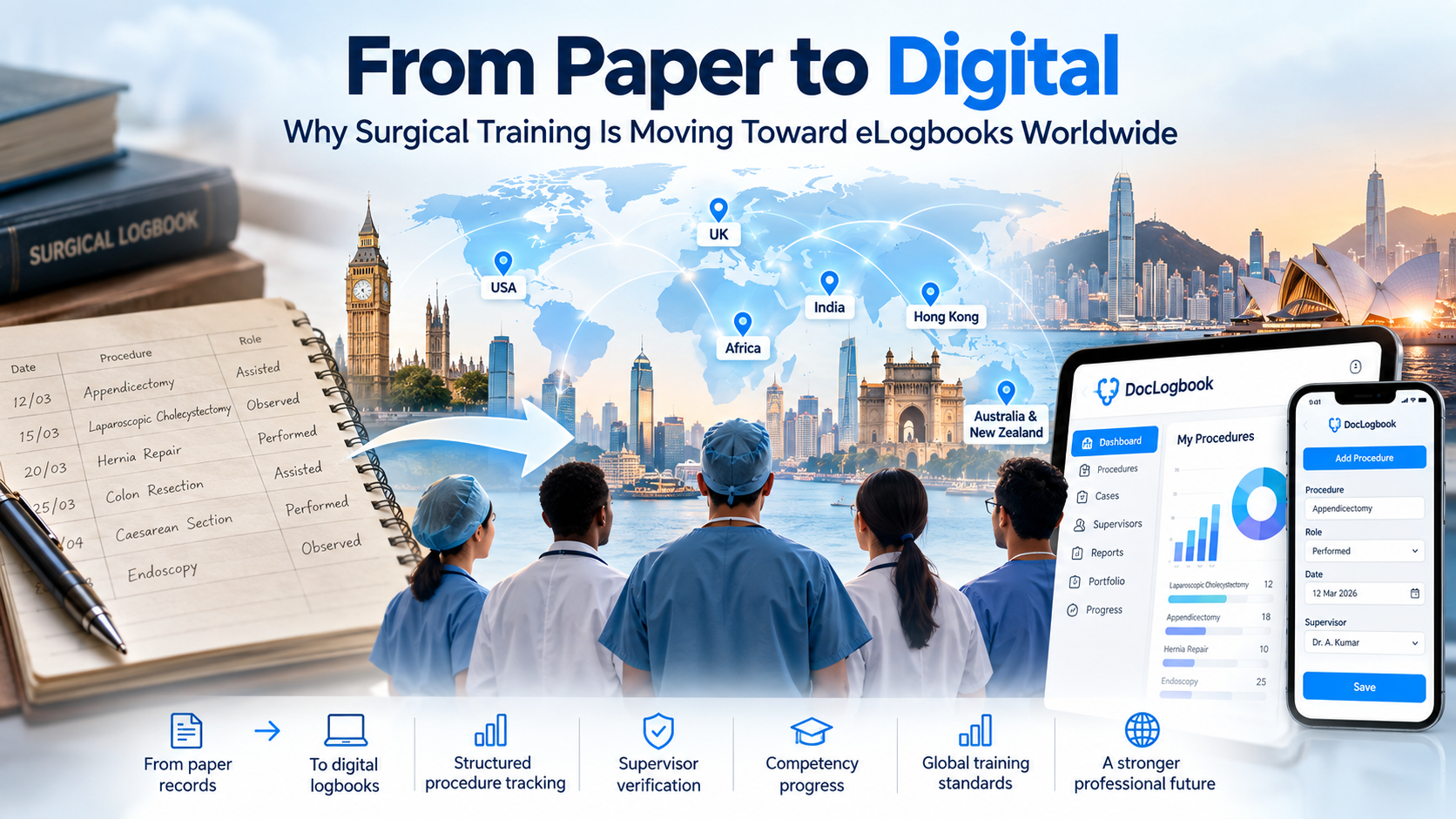
September 2026 | DocLogbook
For generations, doctors and surgical trainees have documented their clinical experience in logbooks. What began as handwritten records of procedures, operations, rotations and competencies is increasingly becoming part of a much larger digital training ecosystem.
Across the UK, India, Africa, Hong Kong, Australia, New Zealand and the United States, medical training organizations are placing increasing emphasis on structured documentation of clinical experience.
One of the latest developments comes from Africa.
A paper published in the World Journal of Surgery in September 2026 describes the evolution of the College of Surgeons of East, Central and Southern Africa (COSECSA) eLogbook, illustrating how electronic surgical logbooks can support surgical training across a large multinational training network.
The message is becoming increasingly clear:
The medical logbook is evolving from a record of procedures into a digital record of a doctor's professional development.
A Major 2026 Development: The COSECSA eLogbook
In September 2026, the World Journal of Surgery published an article titled “Transforming Surgical Training: The Evolution of the COSECSA eLogbook Through a Theory of Change Framework.”
COSECSA operates across a large network of countries in East, Central and Southern Africa.
As surgical training expanded geographically, traditional paper-based documentation became increasingly difficult to manage at scale.
The development of the COSECSA electronic logbook created a structured system through which surgical trainees could document their operative experience while training organizations could monitor progress and training exposure.
The COSECSA system also demonstrates an important feature for regions where internet connectivity may not always be reliable: operative information can be recorded using a mobile device and synchronized later.
COSECSA currently states that electronic logging of operations is mandatory for most candidates.
This represents an important change in how surgical training is documented.
A surgical logbook is no longer simply something a trainee completes before an examination. It can become a continuously updated record of surgical exposure throughout training.
United Kingdom: Millions of Operations Recorded Digitally
The UK has one of the most established examples of electronic surgical case logging.
According to the Royal College of Surgeons of Edinburgh, the Intercollegiate Surgical eLogbook has more than 22,000 active users and over 65 million operation records.
For most UK surgical trainees, maintaining the eLogbook is mandatory.
Importantly, the system does more than count operations.
Trainees can document their involvement in procedures, while accumulated data can contribute to understanding their progression through surgical training.
The system itself continues to evolve.
In January 2026, for example, changes were introduced to hepatopancreatobiliary procedure recording so that involvement in complex procedures could be documented more accurately.
This highlights an important principle in modern medical training:
Knowing that a trainee attended an operation is not enough.
Training programs increasingly need to understand what procedure was performed, what role the trainee played, and how their operative experience is progressing over time.
Hong Kong: Training Records Moving Online
Another notable development occurred in Hong Kong during 2026.
The Hong Kong College of Family Physicians introduced electronic submission of training rotation records through its eTraining platform.
From January 2026, certain community-based trainees were required to submit rotation records electronically.
The system was subsequently expanded to hospital-based trainees from July 2026.
This illustrates another important trend.
Digital medical logbooks are not limited to surgeons.
Family medicine, anaesthesia, pathology and many other specialties require doctors to demonstrate clinical exposure, procedures, rotations, learning activities and competencies during postgraduate training.
The underlying requirement is similar:
Doctors need a reliable way of documenting what they have actually done during training.
India: eLogbooks Becoming Part of Postgraduate Medical Training
India is also moving toward structured electronic documentation of postgraduate training.
National Medical Commission postgraduate guidance includes requirements relating to logbooks and, in some curricula, explicitly refers to e-LogBooks.
For example, NMC guidance for MCh Endocrine Surgery describes regular updating of the logbook, documentation of surgical procedures assisted or performed, and periodic assessment and authentication by the postgraduate guide.
The transition itself is becoming an academic discussion.
In June 2026, the Indian Journal of Ophthalmology published “Issue regarding E-logbook for PG students: Paper to pixels.”
Workshops on implementing electronic logbooks have also begun appearing within Indian medical education.
This transition is particularly important in a country with large numbers of postgraduate residents working across medical colleges, teaching hospitals and training institutions.
Traditional logbooks can create practical problems.
Residents may record cases in notebooks, spreadsheets, messaging applications, or multiple disconnected systems. Information may then need to be reconstructed when departmental reviews, examinations, or credentialing requirements approach.
A structured digital medical logbook can potentially make documentation continuous rather than retrospective.
United States: Procedure Logs as Part of the Learning Portfolio
The same principle appears in postgraduate medical education in the United States.
The Accreditation Council for Graduate Medical Education (ACGME) incorporates documentation of clinical experience into residency training requirements.
For example, 2026 ACGME requirements for Anatomic and Clinical Pathology describe resident learning portfolios that can include case and procedure logs alongside educational activities, examinations, presentations, self-assessment, and learning plans.
This points toward a broader concept.
The future medical logbook may not simply answer:
“How many procedures have you performed?”
It may increasingly help answer:
“How has your professional experience developed?”
Australia and New Zealand: Mandatory Procedural Documentation
The Royal Australian and New Zealand College of Obstetricians and Gynaecologists (RANZCOG) provides trainees with an online logbook for maintaining a mandatory record of procedures, clinics and scans.
Its training framework also considers the trainee's role in a procedure.
This distinction matters.
Two doctors may both record the same operation, but their experience may be completely different.
One may have observed.
Another may have assisted.
Another may have performed most of the operation under supervision.
A useful surgical logbook therefore needs to capture more than procedure names.
It should capture levels of participation and professional progression.
What Is Changing in Medical Logbooks?
Looking across these international examples, several common trends emerge.
1. Paper is gradually being replaced by digital records
Paper logbooks are difficult to search, analyze, back up, and carry throughout a medical career.
Digital systems can make longitudinal documentation substantially easier.
2. Procedure numbers alone are becoming insufficient
Modern training systems increasingly need context around an operation:
- What procedure was performed?
- What was the doctor's role?
- Was the procedure supervised?
- What level of responsibility did the trainee have?
- How much experience has accumulated in that category?
3. Verification is becoming important
A professional logbook becomes more useful when supervisors or training programs can verify relevant clinical experience.
This transforms a personal diary into a potentially more reliable professional training record.
4. Logbook data can reveal training gaps
Consider a surgical resident who has logged 400 operations.
The number initially appears impressive.
But suppose analysis shows:
- 180 minor procedures
- 120 endoscopic procedures
- 70 intermediate operations
- only 20 major operations
- only 10 operations performed independently
The resident does not simply need another 100 operations.
They may need different operative exposure.
That is where structured digital logbook data becomes much more valuable than a simple procedure counter.
The Next Step: From Digital Logbook to Professional Intelligence
The next evolution may already be beginning.
Once professional experience exists as structured digital data, doctors can begin asking much more useful questions.
For example:
Which procedures do I perform most frequently?
Which procedures am I getting insufficient exposure to?
How has my operative independence changed over the last year?
Which hospitals or rotations provided the greatest surgical exposure?
Which areas of my training portfolio need improvement?
This transforms a logbook from a storage system into a tool for professional insight.
Where DocLogbook Fits
DocLogbook was developed around this changing concept of professional documentation.
Instead of allowing valuable clinical experience to remain scattered across paper notebooks, spreadsheets, messaging applications, and personal notes, doctors can maintain a structured digital record of their work.
A digital surgical logbook can help doctors organize procedures, review their professional activity, and maintain a longitudinal record of their clinical experience.
The longer such a record is maintained, the more valuable it can become.
A resident may initially use a medical logbook simply to document training.
Later, the same structured professional history can potentially help with portfolio preparation, credentialing, fellowship applications, appraisal, career planning and understanding one's own clinical practice.
The important idea is simple:
Your clinical experience generates professional data. That data should not disappear.
The Medical Logbook Is Becoming a Career Record
The developments occurring across Africa, the United Kingdom, India, Hong Kong, the United States, Australia and New Zealand point in a similar direction.
Medical education is becoming increasingly structured, measurable and digital.
The traditional paper logbook is therefore evolving as well.
Tomorrow's medical logbook may combine:
Procedure documentation + supervisor verification + competency tracking + portfolio management + analytics + professional insights.
For residents, it can provide evidence of training.
For practicing doctors, it can become a longitudinal record of professional experience.
For training institutions, structured logbook data can help identify whether trainees are receiving appropriate clinical exposure.
The question for doctors may therefore be changing from:
“Do I need to maintain a logbook?”
to:
“How useful will my professional data be five or ten years from now if I start documenting it properly today?”
References
- Transforming Surgical Training: The Evolution of the COSECSA eLogbook Through a Theory of Change Framework. World Journal of Surgery, September 2026. PubMed: https://pubmed.ncbi.nlm.nih.gov/42760865/
- College of Surgeons of East, Central and Southern Africa (COSECSA). Training Platforms and eLogbook. https://www.cosecsa.org/training-platforms/
- Royal College of Surgeons of Edinburgh. Intercollegiate Surgical Logbook. https://www.rcsed.ac.uk/career-hub/trainees/intercollegiate-surgical-logbook/
- Association of Surgeons in Training. Updates to HPB Procedure Recording in the eLogbook, January 2026. https://asit.org/news/2026/updates-to-hpb-procedure-recording-in-the-elogbook
- Royal College of Anaesthetists. Logbook guidance. https://www.rcoa.ac.uk/documents/logbook
- Hong Kong College of Family Physicians. eTraining platform and electronic training records. https://www.hkcfp.org.hk/list_detail_35_2423.html
- National Medical Commission, India. Postgraduate Medical Education Guidelines and curricula. https://www.nmc.org.in/
- Issue regarding E Log book for PG students: Paper to pixels. Indian Journal of Ophthalmology, 2026. https://pmc.ncbi.nlm.nih.gov/articles/PMC13422905/
- Accreditation Council for Graduate Medical Education. 2026 Program Requirements for Graduate Medical Education in Anatomic Pathology and Clinical Pathology. https://www.acgme.org/
- Royal Australian and New Zealand College of Obstetricians and Gynaecologists. Training Requirements and Online Logbook. https://ranzcog.edu.au/training/franzcog/training-requirements/
About DocLogbook
DocLogbook is a digital medical and surgical logbook designed to help doctors and residents systematically record their clinical and procedural experience, organize their professional data, and gain meaningful insights from their work.