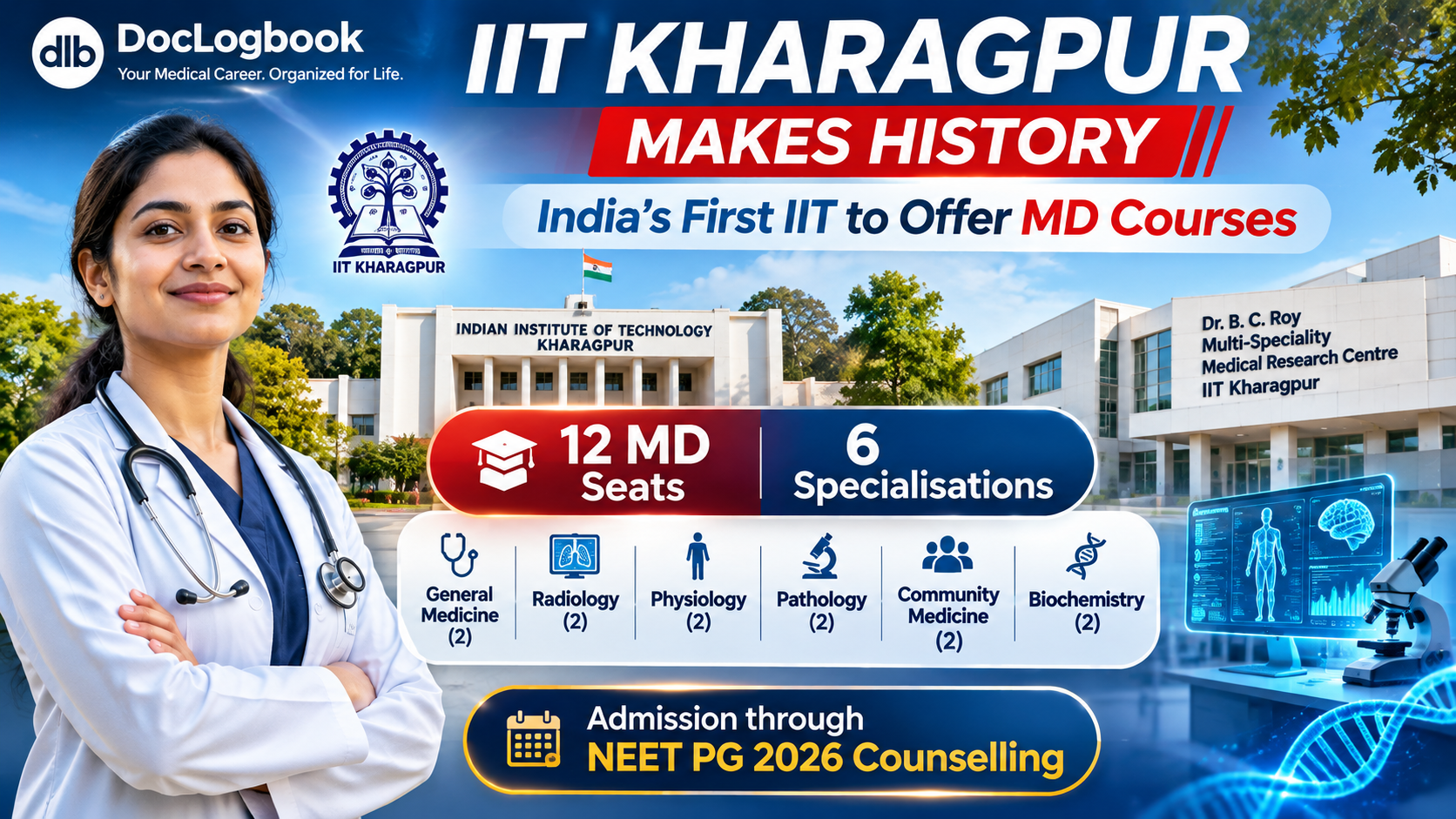
IIT Kharagpur MD Admission 2026–27: First IIT to Offer Medical PG Courses, 12 New Seats and NEET PG Counselling Details
Published: 13 November 2026 | DocLogbook Medical Education News
India's postgraduate medical education system is entering a new era.
In a historic development, the Indian Institute of Technology Kharagpur (IIT Kharagpur) has become the first IIT in India to introduce postgraduate medical degree programmes accredited by the National Medical Commission (NMC).
The institute will offer 12 MD seats across six medical specialisations, beginning with the academic session 2026–27. Admissions will take place through NEET PG 2026 counselling, with the new programmes available for consideration during Round 2.
The announcement, made by the Ministry of Education on 12 November 2026, represents an important milestone in the evolution of medical education in India.
For MBBS graduates and NEET PG aspirants, this is more than the addition of a few postgraduate medical seats. It introduces an opportunity to pursue specialist medical training within an institution internationally recognised for engineering, artificial intelligence, scientific research and technological innovation.
Could this be the beginning of a new model of medical education in India, where doctors are trained not only as clinicians but also as researchers, innovators and healthcare technology leaders?
Here is everything you need to know about IIT Kharagpur MD admission 2026–27, available courses, NEET PG counselling, eligibility, research opportunities, and the potential implications for future doctors.
1. IIT Kharagpur MD Courses 2026: What Is the Latest News?
The Ministry of Education has officially announced that IIT Kharagpur will introduce NMC-accredited MD programmes from the academic session 2026–27.
The postgraduate medical programmes will be conducted at the Dr. B. C. Roy Multi-Speciality Medical Research Centre, Kharagpur, under IIT Kharagpur.
Established in 1951, IIT Kharagpur was India's first Indian Institute of Technology. Seventy-five years later, it is expanding its academic activities into postgraduate medical education.
The new initiative aims to bring together:
- Clinical medicine.
- Engineering and biomedical technology.
- Artificial intelligence in healthcare.
- Medical imaging and diagnostics.
- Scientific research.
- Precision medicine.
- Healthcare innovation.
For the first time, postgraduate medical students will have the opportunity to pursue MD training within India's IIT system.
IIT Kharagpur MD Admission 2026: Key Highlights
| ParticularDetails | |
| Institution | IIT Kharagpur |
| Medical centre | Dr. B. C. Roy Multi-Speciality Medical Research Centre |
| Academic session | 2026–27 |
| Degree | Doctor of Medicine (MD) |
| Total PG medical seats | 12 |
| Number of specialisations | 6 |
| Seats per specialisation | 2 |
| Accreditation | National Medical Commission |
| Entrance examination | NEET PG 2026 |
| Admission process | NEET PG online counselling |
| Counselling round | Available for consideration in Round 2 |
Candidates should consult the official Medical Counselling Committee (MCC) portal for the latest seat matrix, eligibility requirements, and counselling instructions.
2. IIT Kharagpur MD Seats 2026–27: Complete List of Courses
IIT Kharagpur is introducing six postgraduate medical programmes, each with an intake of two students.
MD Specialisation Number of Seats
| MD General Medicine | 2 |
| MD Radiology | 2 |
| MD Physiology | 2 |
| MD Pathology | 2 |
| MD Community Medicine | 2 |
| MD Biochemistry | 2 |
| Total | 12 |
The combination of clinical, preclinical and paraclinical specialisations provides a foundation for interdisciplinary medical education.
MD General Medicine at IIT Kharagpur
General Medicine is one of the most sought-after postgraduate medical specialisations in India.
The introduction of MD General Medicine at IIT Kharagpur could offer opportunities to combine clinical training with research in:
- Artificial intelligence-assisted clinical decision-making.
- Digital health technologies.
- Chronic disease management.
- Precision medicine.
- Predictive healthcare analytics.
- Clinical research.
The broader technological environment may be particularly attractive to doctors interested in developing innovative approaches to patient care.
MD Radiology at IIT Kharagpur
Radiology is a specialty where medicine and technology already intersect extensively.
Artificial intelligence, advanced imaging, image processing, and computational techniques are transforming diagnostic radiology.
Potential interdisciplinary research areas include:
- AI-assisted medical image interpretation.
- Advanced CT and MRI imaging.
- Computer-assisted diagnosis.
- Automated image segmentation.
- Quantitative imaging.
- Medical imaging software development.
For NEET PG aspirants interested in both radiology and healthcare technology, the IIT environment may offer a distinctive academic opportunity.
MD Pathology at IIT Kharagpur
Digital pathology and computational diagnostics are increasingly important in modern medicine.
An MD Pathology programme within an IIT ecosystem may provide opportunities to explore:
- Digital microscopy.
- AI-assisted histopathology.
- Molecular diagnostics.
- Cancer biomarkers.
- Automated laboratory systems.
- Computational pathology.
These research areas could help bridge traditional laboratory medicine and emerging diagnostic technologies.
MD Physiology at IIT Kharagpur
Physiology provides the scientific foundation for understanding the human body.
Potential interdisciplinary areas include biomedical instrumentation, physiological modelling, wearable health technologies, neurophysiology, and human performance research.
MD Community Medicine at IIT Kharagpur
Community Medicine could benefit from collaboration with experts in data science, public health analytics, epidemiology, and digital healthcare systems.
Potential areas of interest include:
- Population health.
- Disease surveillance.
- Healthcare delivery models.
- Predictive epidemiology.
- Digital public health.
- Affordable healthcare technologies.
MD Biochemistry at IIT Kharagpur
Biochemistry connects clinical medicine with molecular science.
An interdisciplinary academic environment may support research in molecular diagnostics, metabolic disorders, biomarkers, genomics, and precision medicine.
Important: These examples represent potential interdisciplinary research opportunities. The actual curriculum, research projects, clinical rotations, and available facilities should be verified with IIT Kharagpur before selecting a programme.
3. IIT Kharagpur MD Admission Through NEET PG 2026
One of the most important questions among medical graduates is:
How can I get admission to an MD programme at IIT Kharagpur?
According to the official announcement, admissions for the 2026–27 academic session will take place through NEET PG online counselling.
The programmes are available for consideration during Round 2 of NEET PG 2026 counselling, subject to the official counselling schedule and seat matrix.
General admission process
- Qualify for NEET PG 2026 under the applicable eligibility criteria.
- Complete registration for the relevant MCC counselling process.
- Review the updated postgraduate medical seat matrix.
- Check the availability of IIT Kharagpur MD courses.
- Include the preferred IIT Kharagpur programme during choice filling.
- Complete choice locking according to MCC instructions.
- Await the seat allotment result.
- If allotted a seat, complete document verification and institutional admission requirements.
Candidates who have already participated in earlier counselling rounds should carefully review the applicable rules concerning eligibility, upgradation, resignation, and participation in subsequent rounds.
Is JEE required for IIT Kharagpur MD admission?
No.
These are postgraduate medical programmes intended for eligible medical graduates. Admission is through NEET PG counselling, not the Joint Entrance Examination (JEE).
Is there a separate IIT entrance examination?
The official announcement specifies NEET PG online counselling as the admission route.
It does not announce a separate IIT entrance examination for these MD programmes.
4. IIT Kharagpur MD Eligibility Criteria 2026
Candidates seeking admission must satisfy the applicable NEET PG and postgraduate medical counselling requirements.
These generally include:
- An eligible MBBS degree or recognised equivalent medical qualification.
- Completion of the required compulsory rotating medical internship by the applicable deadline.
- Valid medical registration, as required.
- Qualification in NEET PG 2026.
- Compliance with MCC counselling and institutional admission requirements.
Applicants must verify the exact eligibility criteria, internship completion deadline, and documentation requirements from the official counselling notices.
International medical graduates seeking admission after obtaining their primary medical qualification outside India should also confirm that they satisfy the applicable Indian medical registration and postgraduate admission requirements.
5. IIT Kharagpur MD Cutoff 2026: What Rank Will Be Required?
The introduction of new postgraduate medical seats has generated considerable interest among NEET PG candidates.
However, there is currently no established historical closing rank for these newly introduced IIT Kharagpur MD programmes.
Since the 2026–27 academic session represents the inaugural intake, previous-year IIT Kharagpur MD cutoff data does not exist.
The actual closing ranks will depend on several factors:
- Number of available seats.
- Candidate preferences.
- Specialty demand.
- Applicable reservation and seat allocation rules.
- NEET PG rank distribution.
- Counselling round.
- Institutional fees and other admission conditions.
Expected competition for MD Radiology and General Medicine
MD Radiology and MD General Medicine are traditionally competitive postgraduate medical specialisations.
With only two seats available in each discipline at IIT Kharagpur, competition may be substantial.
However, it would be premature to predict a specific NEET PG rank without actual allotment data.
Candidates should avoid relying on unofficial cutoff predictions presented as confirmed information.
Where can candidates check the closing ranks?
Official seat allotment results and counselling documents are available through the MCC postgraduate medical counselling portal:
https://mcc.nic.in/pg-medical-counselling/
6. IIT Kharagpur MD Fees, Stipend and Service Bond: What Do We Know?
For many medical graduates, tuition fees, resident stipends, accommodation, and service bond requirements are important considerations when choosing a postgraduate medical college.
The Ministry of Education announcement confirms the new MD programmes and seat intake but does not specify detailed financial and employment conditions for postgraduate residents.
Admission Factor Current Information
| MD tuition fees | Verify official institutional fee structure |
| Monthly resident stipend | Verify official institutional notification |
| Hostel fees | Check institutional admission documents |
| Service bond | Check applicable admission conditions |
| Seat resignation penalty | Refer to MCC and institutional rules |
| Resident duty arrangements | Confirm with the medical centre |
Candidates should not assume that IIT Kharagpur MD fees or resident stipends will be identical to those at AIIMS, government medical colleges, central universities or other IIT programmes.
Before locking choices, applicants should obtain accurate information about the financial and academic conditions of their preferred course.
7. Why Is IIT Kharagpur Entering Postgraduate Medical Education?
Medicine is undergoing a significant technological transformation.
Artificial intelligence is increasingly being explored in diagnostics, medical imaging, and clinical decision support. Biomedical engineers are developing new medical devices. Robotics is transforming surgical techniques. Data science is improving our understanding of disease patterns and healthcare delivery.
Yet traditional medical education and technological education have often developed within separate institutional environments.
IIT Kharagpur's entry into postgraduate medical education seeks to create opportunities for collaboration between these disciplines.
The institute's established expertise in engineering, computational sciences, artificial intelligence, biomedical research, and technological development provides a foundation for this initiative.
The long-term vision is to develop medical specialists who can contribute not only to clinical care but also to research and innovation.
This could help create a new generation of:
- Physician-scientists.
- Clinician-innovators.
- Medical technology researchers.
- Digital health entrepreneurs.
- Specialists with interdisciplinary research expertise.
The initiative is also aligned with India's broader ambition of developing accessible, affordable, and technology-enabled healthcare.
8. Artificial Intelligence in Medical Education: Why This Development Matters
Artificial intelligence in healthcare is no longer limited to theoretical research.
AI systems are being developed and evaluated for applications including:
- Detection of abnormalities on medical imaging.
- Clinical decision support.
- Prediction of disease progression.
- Automated laboratory analysis.
- Medical documentation.
- Drug discovery.
- Personalised treatment planning.
- Population health management.
For future doctors, understanding how these technologies work — including their limitations — may become increasingly important.
An interdisciplinary medical education environment could allow postgraduate students to collaborate with engineers, computer scientists and biomedical researchers.
What could this mean for resident doctors?
A radiology resident could participate in research involving AI-based image analysis.
A pathology resident could explore digital histopathology.
A general medicine resident could investigate predictive models for chronic diseases.
A community medicine resident could collaborate on population health data systems.
These are illustrative possibilities, not confirmed mandatory components of the IIT Kharagpur MD curriculum.
The value of such collaborations will depend on the actual academic structure, available mentorship, and research opportunities.
Importantly, AI should complement clinical judgement rather than replace it. Future medical professionals must understand patient safety, data privacy, algorithmic bias, and the importance of clinical validation.
9. IIT Kharagpur vs Traditional Medical Colleges: What Could Be Different?
The introduction of MD courses at IIT Kharagpur raises an interesting question:
Should medical graduates choose an IIT-based medical programme over a traditional medical college?
The answer depends on individual career goals and the quality of the specific training programme.
Factor IIT-Based Medical Education Traditional Medical College
| Academic environment | Potentially greater integration with engineering and technology | Established medical education ecosystem |
| Clinical training | Depends on hospital facilities, patient volume, and programme structure | Depends on institution and specialty |
| Research opportunities | Potential access to interdisciplinary technological research | Varies by institutional research infrastructure |
| Artificial intelligence | Potential collaboration with AI and computational researchers | Increasingly available at selected institutions |
| Medical alumni network | New postgraduate medical programme | Often established medical alumni network |
| Previous training outcomes | Not yet available for the inaugural MD cohort | May have historical training and examination outcomes |
| Clinical mentorship | Depends on appointed faculty and programme arrangements | Depends on department and faculty |
The IIT name alone should not determine a candidate's postgraduate medical choice.
For clinical specialties, the quality of clinical exposure, patient volume, faculty mentorship and practical training remains essential.
An institution's reputation in engineering does not automatically establish the quality of every new medical training programme.
Candidates should assess the specific department rather than rely exclusively on the institutional brand.
10. Should NEET PG Aspirants Choose IIT Kharagpur for MD?
IIT Kharagpur may be particularly attractive to medical graduates interested in combining clinical medicine with scientific research, technology and innovation.
However, candidates should evaluate several practical considerations.
Clinical exposure
How many patients does the medical centre manage?
What is the range of clinical conditions encountered by postgraduate residents?
Are adequate emergency, inpatient and outpatient training opportunities available?
Faculty and mentorship
Who are the faculty members in the selected department?
What are their clinical qualifications, teaching experience, and research interests?
Infrastructure
What diagnostic, laboratory, and clinical facilities are available?
For radiology candidates, what imaging equipment and reporting exposure will be provided?
Research opportunities
Can residents collaborate with other IIT departments?
Are there established research projects, laboratories, and supervisors available to medical postgraduate students?
Financial considerations
What are the tuition fees, monthly stipends, accommodation costs, and service bond conditions?
Academic outcomes
How will clinical competencies, examinations, thesis requirements and postgraduate progression be assessed?
Since this is the first MD cohort, historical resident feedback and alumni outcomes are not yet available.
Candidates should therefore obtain as much direct information as possible from the institution before finalising their choices.
11. Could Other IITs Introduce Medical PG Courses in the Future?
IIT Kharagpur's entry into postgraduate medical education may encourage broader discussions about integrating medicine with engineering and technology across Indian higher education.
Several IITs are already involved in biomedical engineering, healthcare technology, medical research, and collaborations with hospitals.
However, introducing an NMC-accredited postgraduate medical programme requires more than an established engineering or research department.
It involves appropriate clinical infrastructure, qualified medical faculty, patient care facilities and compliance with regulatory requirements.
Whether other IITs will introduce similar MD programmes will depend on institutional decisions, regulatory approvals and the development of suitable medical training facilities.
There is currently no basis to assume that all IITs will begin offering MD or MS courses.
Nevertheless, IIT Kharagpur's initiative provides an important example of how technological institutions may contribute to future medical education.
12. The Future of Medical Education in India: Beyond Entrance Examination Ranks
Much of the discussion surrounding postgraduate medical education in India focuses on NEET PG ranks, seat availability, counselling and specialty selection.
These factors are important.
But medical education must also address a broader question:
What kind of doctors should India train for the healthcare challenges of the next several decades?
Future specialists will need strong clinical knowledge and practical competence. They may also benefit from skills in:
- Medical research and evidence appraisal.
- Digital healthcare systems.
- Artificial intelligence literacy.
- Clinical data analysis.
- Healthcare quality improvement.
- Medical device innovation.
- Patient safety.
- Interdisciplinary collaboration.
The introduction of MD programmes at IIT Kharagpur is relevant to this wider conversation.
It offers an opportunity to explore how traditional medical training can coexist with technological innovation.
However, the success of this model will ultimately depend on the quality of postgraduate training, clinical outcomes, research productivity, and the experiences of its residents.
13. Why Medical Logbooks Will Become More Important for Future Doctors
As postgraduate medical education evolves, the importance of structured clinical documentation is likely to increase.
A resident's professional development cannot be understood through examination results alone.
Clinical experience, procedural exposure, academic activities, research participation, and professional competencies all contribute to the development of a specialist.
A well-maintained medical logbook can help residents organise their training experience and reflect on their professional progress.
For example, an MD General Medicine resident may wish to document:
- Clinical cases and diagnoses.
- Procedures performed.
- Intensive care exposure.
- Academic presentations.
- Clinical learning experiences.
- Professional milestones.
Similarly, an MD Radiology resident may wish to maintain records of imaging exposure, diagnostic cases, procedures and academic activities.
A digital medical logbook can make these records easier to organise and review over time.
14. How DocLogbook Helps Medical Students, Residents and Specialists
DocLogbook is a free digital medical and surgical logbook designed to help doctors organise their professional careers.
Whether you are an MBBS student preparing for NEET PG, an MD or MS resident, a DNB trainee, a surgeon or an experienced consultant, maintaining organised professional records can support your long-term career development.
Digital clinical and surgical case logging
Record clinical cases, procedures, and surgical experience in a structured digital format while protecting patient confidentiality.
Multi-hospital professional tracking
Maintain professional records across different hospitals and clinical appointments.
Professional insights with DocPulse AI
Explore insights from your recorded professional activities to better understand your clinical experience and career progress.
Build your medical career portfolio
Organise your professional experience for future CV preparation, fellowship applications, academic development, and international career opportunities.
Access your records across devices
DocLogbook is available on:
- Google Play Store.
- Apple App Store.
- Web.
Free to use. Built for doctors. Growing with doctors.
Visit: https://www.doclogbook.com
DocLogbook complements structured medical training and professional documentation. It does not replace mandatory institutional logbooks, NMC requirements, or official competency assessments.
15. IIT Kharagpur MD Admission 2026–27: Frequently Asked Questions
Is IIT Kharagpur offering MD courses?
Yes. IIT Kharagpur has introduced NMC-accredited postgraduate MD programmes beginning with the 2026–27 academic session.
Which is the first IIT to offer postgraduate medical degrees?
IIT Kharagpur is the first Indian Institute of Technology to introduce NMC-accredited postgraduate medical degree programmes.
How many MD seats are available at IIT Kharagpur?
The announced intake is 12 seats across six specialisations, with two seats in each discipline.
Which MD courses are available at IIT Kharagpur?
The six announced courses are MD General Medicine, MD Radiology, MD Physiology, MD Pathology, MD Community Medicine and MD Biochemistry.
Is IIT Kharagpur offering MS General Surgery?
MS General Surgery is not included in the six postgraduate programmes announced for the 2026–27 academic session.
Is IIT Kharagpur offering MD Radiology?
Yes. Two MD Radiology seats have been announced.
Is IIT Kharagpur offering MD General Medicine?
Yes. Two MD General Medicine seats have been announced.
Is NEET PG required for IIT Kharagpur MD admission?
Yes. Admissions to the announced MD programmes will take place through NEET PG online counselling.
Can I get IIT Kharagpur MD admission through JEE?
No. These are postgraduate medical programmes, and admission is through NEET PG counselling.
Are IIT Kharagpur MD seats available in NEET PG Round 2?
The official announcement states that the programmes are available for consideration during Round 2 of NEET PG 2026 counselling, subject to the official seat matrix and counselling requirements.
What is the NEET PG cutoff for IIT Kharagpur MD Radiology?
No historical closing rank is available because the programme is being introduced. The actual cutoff will become clearer after official seat allotment.
What is the fee for IIT Kharagpur MD courses?
The Ministry of Education announcement does not specify the detailed fee structure. Candidates should consult official institutional admission documents.
What is the monthly stipend for MD residents at IIT Kharagpur?
Candidates should verify the official stipend notification or institutional admission documents. A confirmed stipend amount should not be inferred from other medical colleges or IIT programmes.
Is IIT Kharagpur MD recognised by NMC?
The Ministry of Education has announced the programmes as NMC-accredited postgraduate medical degrees.
Will IIT Kharagpur offer MBBS courses?
The November 2026 announcement concerns six postgraduate MD programmes. It does not announce a new MBBS intake.
Is IIT Kharagpur a good option for doctors interested in artificial intelligence?
Its interdisciplinary technological environment may be attractive to doctors interested in AI, biomedical engineering, and healthcare research. However, candidates should evaluate actual clinical training, research access, and departmental facilities.
Will other IITs start MD programmes?
IIT Kharagpur's initiative may encourage similar developments, but future programmes at other IITs will require separate institutional decisions and regulatory approvals.
Conclusion: IIT Kharagpur Opens a New Chapter in Indian Medical Education
The introduction of MD programmes at IIT Kharagpur is a historic milestone for India's postgraduate medical education system.
With 12 seats across six specialisations, the inaugural programme offers medical graduates an opportunity to pursue postgraduate training within an established technological and scientific institution.
The potential to connect clinical medicine with engineering, artificial intelligence, biomedical science and research makes this development particularly significant.
However, the true success of the initiative will depend on its ability to deliver high-quality clinical training, effective mentorship, meaningful research opportunities, and strong professional outcomes for postgraduate residents.
For NEET PG aspirants, IIT Kharagpur represents an exciting new option. Candidates should carefully review the official counselling information, clinical facilities, faculty, fees, and training arrangements before selecting a programme.
For Indian medical education, this development raises a larger question:
Can the next generation of doctors become not only excellent clinicians, but also innovators capable of shaping the future of healthcare?
As medicine continues to evolve, doctors will need to organise their clinical experience, develop new competencies, and maintain a structured record of their professional journey.
DocLogbook — Your Medical Career. Organized for Life.
Official Sources and Useful Links
1. Ministry of Education, Government of India — Official announcement, 12 November 2026
India's first IIT introduces NMC-accredited postgraduate medical programmes.
https://www.pib.gov.in/PressReleasePage.aspx?PRID=2335480
2. Medical Counselling Committee — PG Medical Counselling
Official counselling schedule, registration, seat allotment, and admission information.
https://mcc.nic.in/pg-medical-counselling/
3. MCC — Current PG Counselling Events
Updated seat matrices, counselling notices, and information regarding seat additions or removals.
https://mcc.nic.in/current-events-pg/
4. IIT Kharagpur — Medical Centre
https://www.iitkgp.ac.in/department/SH
5. National Medical Commission
6. National Board of Examinations in Medical Sciences
Disclaimer: This article is based on the official Ministry of Education announcement dated 12 November 2026 and provides general educational and admission information. Seat availability, counselling eligibility, fees, stipends, admission conditions, and other institutional requirements may change. Candidates should verify the latest information directly with MCC, NMC and IIT Kharagpur before making admission decisions.