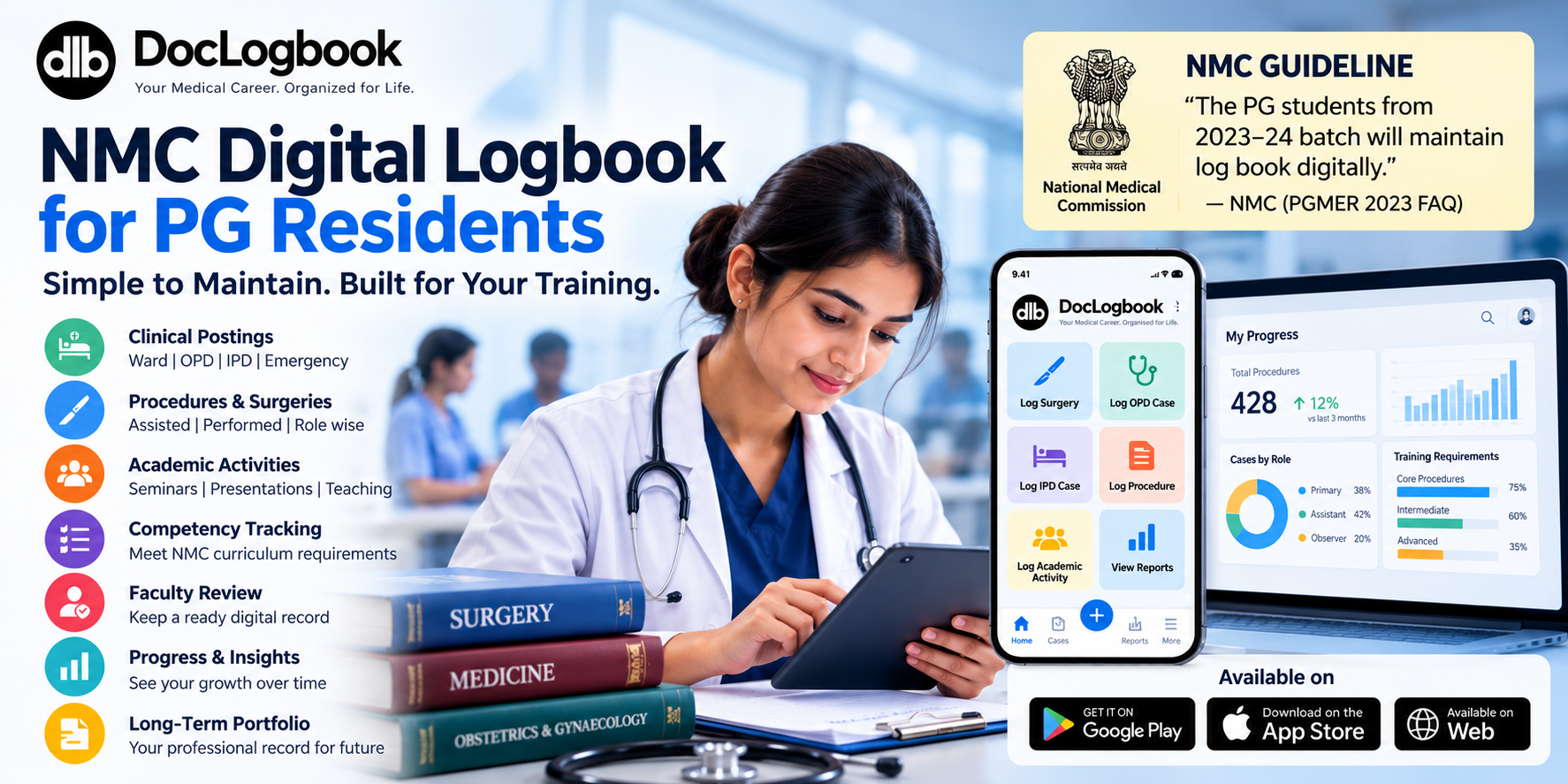
NMC requires PG residents to maintain their logbook digitally. Here's what residents need to record—and how DocLogbook can make everyday logbook maintenance much easier.
For most postgraduate medical residents, maintaining a logbook sounds simple.
Then residency starts.
Ward rounds, OPDs, emergency duties, surgeries, procedures, seminars, presentations, rotations, and examinations quickly take over everyday life.
Cases accumulate.
Procedures get forgotten.
And the logbook that was supposed to be updated regularly often becomes something residents struggle to reconstruct later.
This is exactly where a digital medical logbook can make a difference.
The National Medical Commission (NMC) has moved postgraduate training toward digital documentation. In its FAQ on the Post-Graduate Medical Education Regulations (PGMER) 2023, NMC specifically states:
“The PG students from the 2023-24 batch will maintain a logbook digitally.”
So what exactly should a PG resident maintain?
And can it be made simpler?
What Does NMC Expect PG Residents to Maintain in Their Logbook?
NMC's competency-based postgraduate curricula provide a clear idea of the purpose of the logbook.
Although exact requirements vary between specialties, the broad principles are consistent.
1. Maintain a digital logbook
For PG students from the 2023–24 batch, NMC's FAQ on PGMER-2023 states that the logbook will be maintained digitally.
This represents an important transition from the traditional handwritten PG logbook toward electronic documentation.
2. Record your clinical postings
The logbook should document the duration and nature of work undertaken during different postings.
Depending on the specialty, this may include:
Ward | OPD | Emergency/Casualty | Specialty rotations | Other clinical postings
The objective is to create a record of the resident's actual training exposure.
3. Record procedures assisted and performed
This is particularly important for surgical and procedure-based specialties.
NMC guidance has long required PG residents to document procedures, including operations assisted or performed.
For MS and MCh trainees, the distinction between assisting and independently performing operations is particularly relevant.
Instead of remembering hundreds of procedures at the end of residency, residents should ideally record them as they happen.
4. Make entries in real time
NMC competency-based postgraduate curriculum guidance states that logbook entries should be made in real time.
This makes sense.
Trying to remember the details of dozens of patients and procedures several weeks or months later is difficult and can result in incomplete records.
A digital logbook on your phone makes this significantly easier.
5. Record academic activities
Residency is not only about procedures.
Depending on the specialty curriculum, the logbook may also document educational and academic activities such as:
Teaching sessions | Seminars | Journal clubs | Case presentations | Academic activities
These activities collectively demonstrate the resident's participation in the postgraduate training programme.
6. Track competencies and required activities
NMC describes the logbook as a mechanism for recording completion of predetermined activities and acquisition of selected competencies.
This is an important distinction.
A good PG logbook should not simply answer:
“How many cases did I see?”
It should help demonstrate:
“What experience and competencies did I acquire during my training?”
7. Faculty should periodically review the logbook
The PG logbook is not intended to remain only a private diary.
NMC guidance describes periodic checking and assessment by the faculty members responsible for training.
The logbook can therefore help faculty understand a resident's clinical exposure and identify areas where additional experience may be required.
The Problem: Maintaining a Logbook During Residency Is Hard
The NMC requirements are understandable.
The practical problem is maintaining the record while simultaneously working as a resident.
Consider a typical surgical resident.
During a busy day, they may attend an OPD, evaluate several admitted patients, assist in two operations, perform a minor procedure, attend an academic session, and then go on emergency duty.
At the end of that day, maintaining a detailed paper logbook is understandably not the first thing on their mind.
One day becomes one week.
One week becomes one month.
Eventually the resident may have dozens—or hundreds—of cases to reconstruct.
That defeats one of the main purposes of a logbook.
A logbook should document your training as it happens.
This Is Where DocLogbook Can Help
DocLogbook is a digital medical and surgical logbook built specifically for doctors.
Instead of maintaining scattered notes, spreadsheets or handwritten lists, residents can maintain their professional experience digitally in one place.
📱 Log Cases From Your Phone
A resident can record clinical and surgical activity digitally rather than waiting to update a paper diary later.
The basic workflow is simple:
Do the case → Log the case → Build your professional record
The easier the process is, the more practical real-time documentation becomes.
🏥 Record OPD, IPD and Surgical Work
DocLogbook supports structured recording of surgeries, OPD, and IPD activity, helping residents maintain a more organized record of their clinical experience.
Different specialties and doctors may require different information, so customizable forms can be used to organize case information according to professional needs.
🔪 Keep Your Surgical Experience Organized
For surgical residents, simply writing the name of an operation is often insufficient.
Your role matters.
Over the course of training, your experience should ideally progress from:
Observed → Assisted → Performed under supervision → Increasing operative independence
A structured digital record makes it much easier to understand this progression than hundreds of handwritten entries.
📊 Turn Your Logbook Into Useful Data
This is where a digital logbook becomes much more powerful than paper.
Imagine reaching the second year of residency and being able to understand:
How many procedures have I logged?
Which procedures do I perform most frequently?
Which areas have relatively little exposure?
How is my clinical experience developing?
Your logbook stops being just a requirement.
It becomes a tool for understanding your training.
🔎 Find Your Cases When You Need Them
Paper logbooks become increasingly difficult to search as the number of entries grows.
Digital records can make it much easier to organize and retrieve your professional information when required.
That can become particularly valuable after hundreds or thousands of clinical encounters.
📄 Build a Long-Term Professional Record
Residency eventually ends.
Your professional career does not.
The cases and procedures you perform during residency form the beginning of your professional history.
DocLogbook is designed around the idea that doctors should maintain this experience as a longitudinal professional record, rather than abandoning their logbook after the final examination.
The same professional data can contribute to building and maintaining your career profile and CV over time.
And Residents Can Start for Free
One of the biggest barriers to adopting professional software during residency is cost.
Residents already have enough expenses.
Maintaining your professional experience should not require an expensive enterprise system just to get started.
PG residents can sign up for DocLogbook for free and start building their digital professional record.
That means a resident can start logging cases from the beginning of training rather than waiting until hundreds of cases have already accumulated.
NMC Requirement vs How DocLogbook Can Help
| NMC-aligned logbook needs: How DocLogbook can help | |
| Digital logbook | Maintain your professional logbook digitally |
| Regular/real-time documentation | Log cases conveniently from your phone |
| Clinical work | Record surgeries, OPD and IPD activity |
| Procedures assisted/performed | Maintain structured procedural experience |
| Different postings/experience | Organize professional activity across workplaces and clinical settings |
| Competency/progress monitoring | Review patterns in your recorded clinical experience |
| Periodic review | Keep an organized digital record that can support review |
| Long-term documentation | Preserve professional experience beyond residency |
Don't Wait Until the End of Residency
This may be the most important advice for a new PG resident.
Start your logbook on Day 1.
Imagine two residents finishing three years of postgraduate training.
One tries to reconstruct their experience from old notebooks, hospital records, and memory.
The other has been documenting their cases throughout residency.
At the end of three years, the second resident doesn't simply have a logbook.
They have a structured record of how they became a specialist.
And that record can remain valuable long after the final examination.
Your Residency Is Building Your Professional Data
Every OPD.
Every procedure.
Every operation you assist.
Every operation you perform.
Every rotation.
Every new skill.
Together, these experiences tell the story of your medical training.
NMC's move toward digital logbooks recognizes the increasing importance of structured documentation in postgraduate medical education.
Technology can make that documentation considerably easier.
DocLogbook helps PG residents build their digital medical and surgical logbook one case at a time—without having to wait until the end of residency to remember what they did.
Start Your Digital Logbook for Free
Don't wait until your final year to reconstruct your residency.
Start recording your professional journey today with DocLogbook.
Log. Track. Learn. Grow.
References
National Medical Commission — FAQs on Post-Graduate Medical Education Regulations, 2023: NMC states that PG students from the 2023–24 batch will maintain the logbook digitally.
National Medical Commission — Competency-Based Postgraduate Training Guidelines: Specialty curricula describe recording postings, procedures assisted/performed, teaching sessions, predetermined activities, and selected competencies, with real-time entries and periodic faculty assessment.
Note: Specific logbook requirements can vary by specialty, institution, and university. DocLogbook is a documentation tool and should be configured/used alongside the applicable NMC specialty curriculum and your institution's requirements. Use of DocLogbook should not be represented as NMC certification or endorsement.